All HTTP methods
GET, POST, PUT, PATCH, DELETE. Pick the right verb for every endpoint you need to test.
Spectra sends real requests to your API endpoints — with custom methods, headers, auth, and a request body — then asserts the response is exactly what you expect. When it isn't, you hear about it immediately.
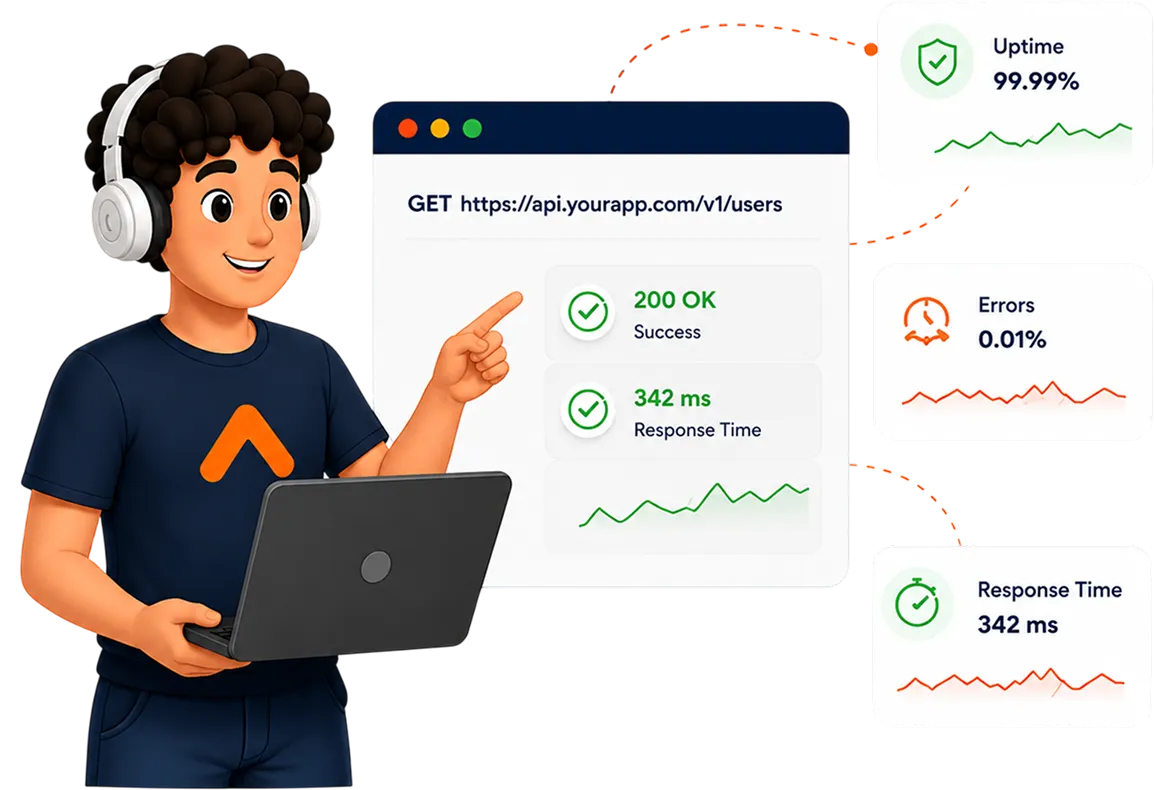
Enter your API endpoint, method, headers, and expected values.
Choose from multiple global locations to run your API checks.
Pick how often we should test your API.
Spectra validates response time, status codes, and content in real time.
Receive alerts on any failure through your preferred notification channels.
An assertion is a rule that defines what a passing response must look like. Stack multiple assertions on a single monitor — every one must pass for the check to be marked UP. If any fails, even on an HTTP 200, we treat the endpoint as DOWN and fire your alerts.
Pro tip
Use JSON field assertions with dot notation to check nested values — e.g.
data.user.active
equals true. That
verifies the actual business logic of your API, not just that it responded.
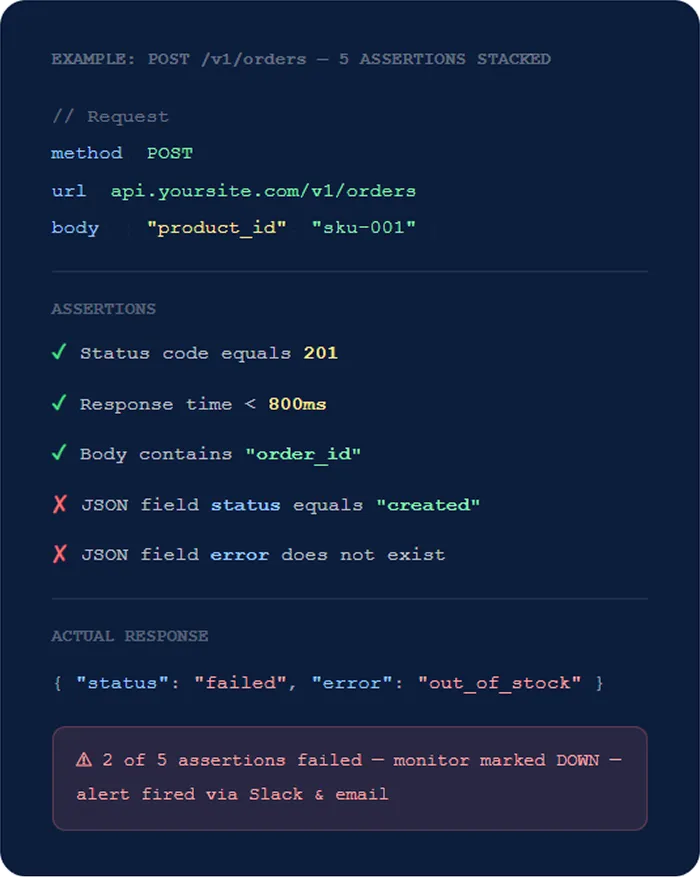
Full request control, flexible assertions, and multi-region verification — per endpoint, per environment.
GET, POST, PUT, PATCH, DELETE. Pick the right verb for every endpoint you need to test.
Bearer token, API key, Basic auth, or any custom header combination your API requires.
Assert exact JSON field values using dot notation. Catch wrong data even when the status code is 200.
Send a real JSON payload or form data with every check. Test creation and update endpoints properly.
Run checks from multiple regions. 2+ must confirm failure before any alert fires — zero false positives.
No agents to install. No SDKs to integrate. Paste your endpoint URL and you're live.
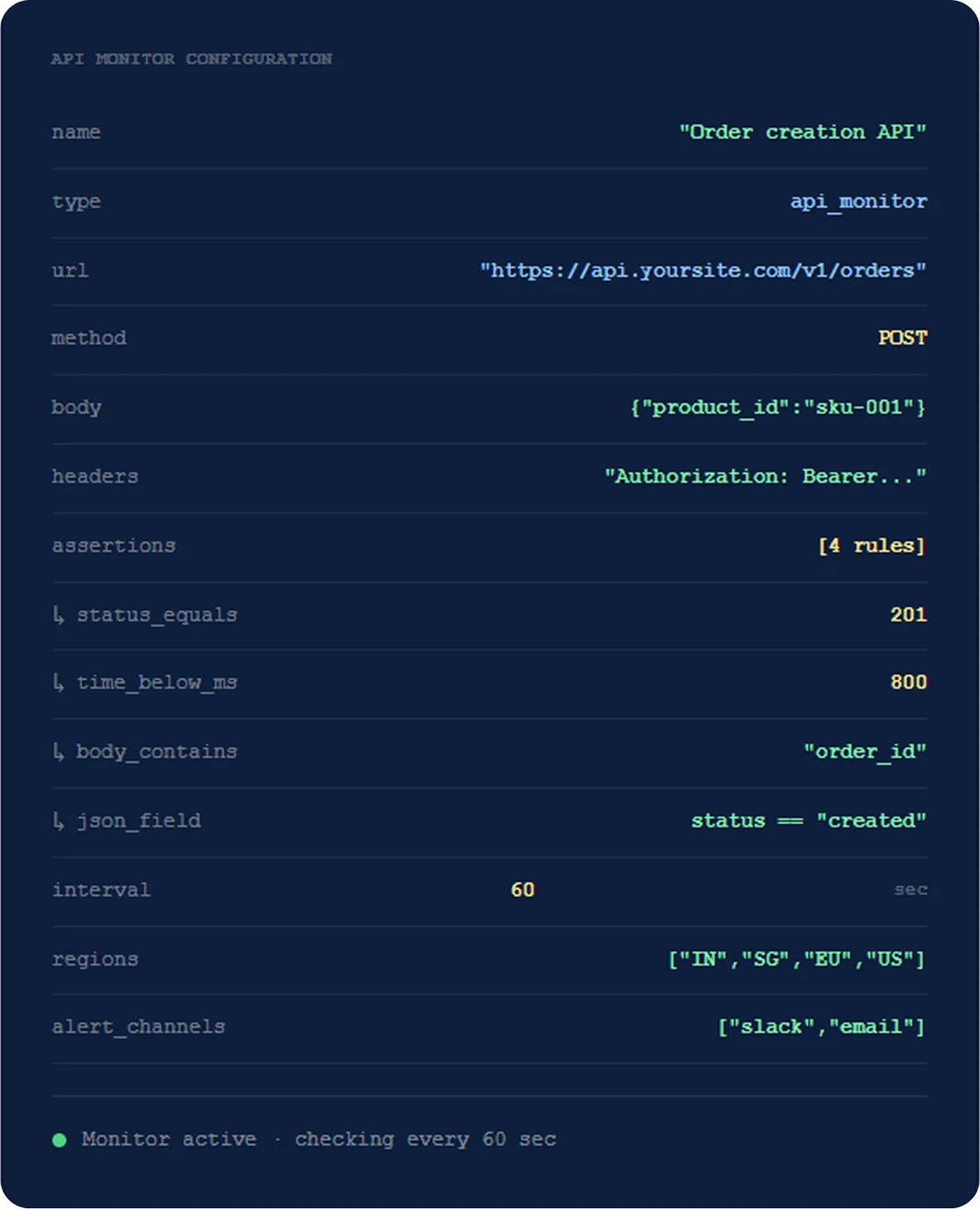
Give it a descriptive name — "Order creation API" or "Auth token refresh". Select API Monitor from the type picker.
Paste the full endpoint URL, choose the HTTP method, and add a JSON request body for POST/PUT/PATCH endpoints.
Add any headers your API needs — Bearer token, API key, Basic auth. Credentials are encrypted and never exposed in alerts.
Add one or more assertion rules — status code, JSON fields, response time, body content. All must pass for the check to be UP.
Ensure API reliability across environments.
Detect issues in integrations instantly.
Maintain uptime for critical API services.
Protect transactions and customer experience.
Monitor client APIs from one central dashboard.
Monitor complex APIs at scale with ease.
Answers to common questions teams ask us
A rule your API response must satisfy — a status code, a maximum response time, a header value, or a specific JSON field. If any assertion fails, Spectra raises an incident.
Yes. Add bearer tokens, API keys, basic auth, or custom headers per monitor. Secrets are encrypted and never shown in logs.
Absolutely. Assert on nested fields, types, and exact values — so a 200 that returns the wrong data still fails the check.
You can chain requests and pass values between them to test real journeys like login → fetch → update.
From every five minutes on the free plan down to every 30 seconds on Pro+, across all the regions you select.